
How to Choose a Safe and Fair Bitcoin Casino in Canada: A 2026 Player's Guide to Licensing, Payouts, and Provably Fair Gaming
How to Choose a Safe and Fair Bitcoin Casino in Canada: A 2026 Player's Guide to Licensing, Payouts, and Provably Fair Gaming
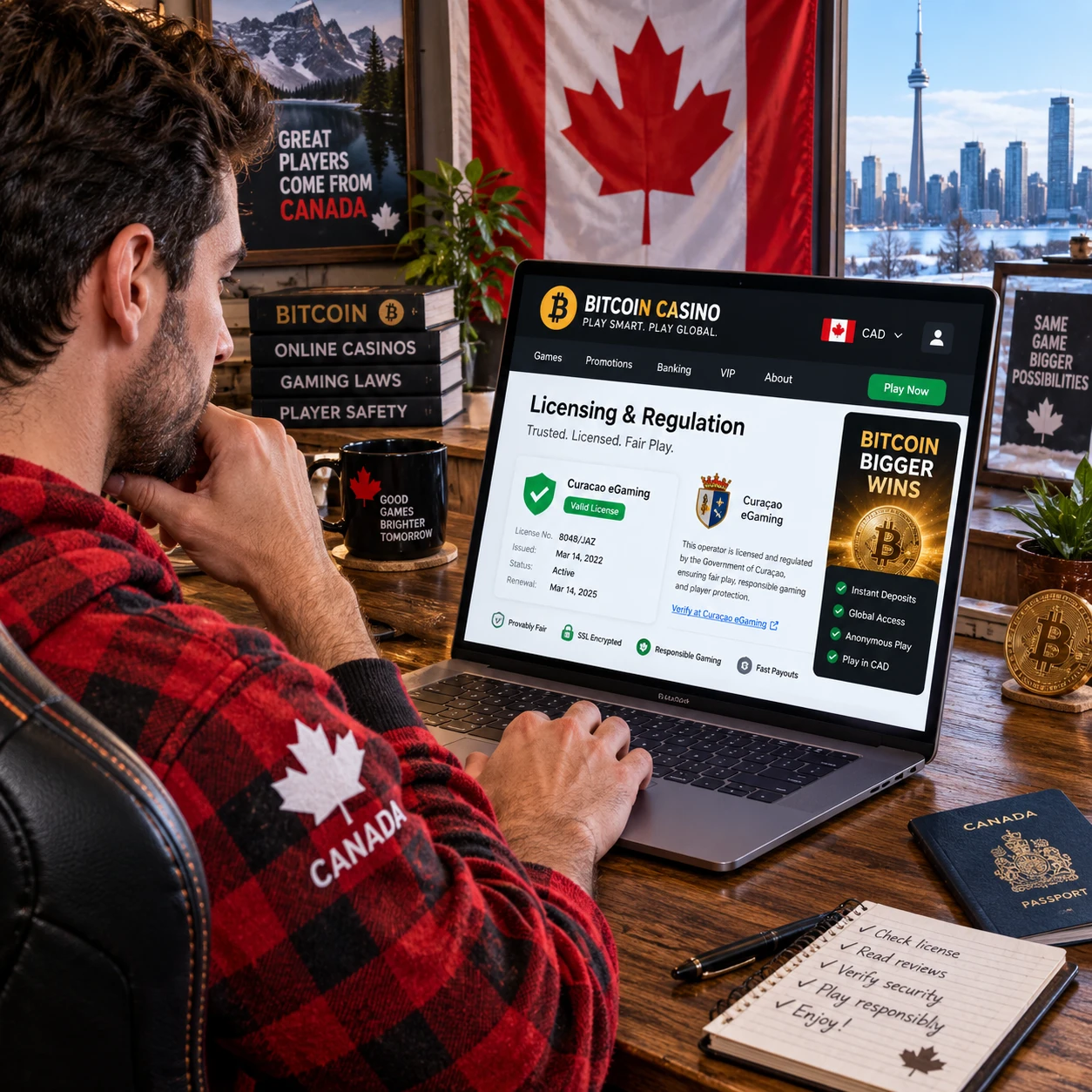
Crypto gambling has quietly become one of the fastest-growing corners of Canada's online entertainment scene. More players across Ontario, Alberta, and British Columbia are turning to Bitcoin casinos for the near-instant deposits, the relative privacy, and the sense that blockchain technology somehow makes everything more trustworthy. That last part isn't automatically true, though. For every well-run platform offering transparent payouts and verifiable game outcomes, there are a handful of unlicensed operators banking on the fact that most players never check the fine print.
I've spent a lot of time digging through terms of service, licensing registries, and payout policies for this guide, mainly because I kept seeing the same mistakes repeated in Canadian gambling forums. This article isn't about hype or bonus chasing. It's a practical framework you can actually use before you send your first satoshi to any platform in 2026.
What Makes a Bitcoin Casino Different From a Traditional Online Casino
At the surface level, a Bitcoin casino looks like any other online gambling site—slots, table games, live dealers. The real difference sits underneath, in how money moves and how outcomes get verified. Traditional online casinos rely on fiat processors, bank transfers, and third-party payment gateways that can take days to clear withdrawals. Crypto casinos skip most of that friction by settling transactions directly on the blockchain, which means deposits often confirm within minutes and withdrawals can, in theory, be nearly instant.
The blockchain also introduces a layer of transparency that fiat systems simply don't have. Every transaction is publicly recorded, so if a casino claims a payout went through, you can actually trace it on-chain. That transparency extends into gameplay too, through something called provably fair technology, which I'll get into shortly.
Common Cryptocurrencies Accepted (BTC, ETH, USDT, LTC)
Bitcoin remains the dominant currency on most Canadian-facing platforms, largely because of brand recognition and liquidity. That said, Ethereum and Litecoin have carved out solid followings, especially among players who want faster or cheaper network fees. Stablecoins like USDT are increasingly popular too, since they let players avoid the volatility of holding BTC or ETH while waiting to cash out. If a platform only supports one coin, that's not necessarily a red flag, but broader support usually signals a more mature operator.
Licensing and Regulation—Why It Matters for Canadian Players
Canada doesn't have a single federal body overseeing online gambling the way some countries do. Provinces like Ontario regulate their own markets through iGaming Ontario, but most crypto-focused casinos operate under offshore licenses—Curaçao, Malta, or the Kahnawake Gaming Commission, which is based right here on Mohawk Territory in Quebec and has issued licenses for decades.
Licensing matters because it's the only real enforcement mechanism players have access to. A licensed operator has agreed to dispute resolution processes, minimum fairness standards, and some level of financial auditing. An unlicensed site has agreed to nothing, and if your withdrawal gets 'delayed' indefinitely, you have zero recourse. Red flags include no visible license number anywhere on the site, generic 'licensed and regulated' claims without a regulator name, or a license number that doesn't match the operator's actual business name when you look it up.
How to Verify a License in Under 5 Minutes
This step takes less time than most people spend picking a welcome bonus. Scroll to the footer of the casino's homepage and find the license number—it's usually there, though sometimes buried. Copy that number and head to the regulator's official site, whether that's Curaçao eGaming, the Malta Gaming Authority, or the Kahnawake Gaming Commission registry. Search the license number directly. The registered operator name should match what's displayed on the casino site. If it doesn't match, or the license doesn't exist in the registry at all, walk away immediately.
Understanding Provably Fair Gaming

Provably fair is the feature that genuinely sets crypto casinos apart from traditional ones. In simple terms, it's a cryptographic system that lets you verify, after the fact, that a game's outcome wasn't manipulated in the casino's favor. It typically works through a seed-hash-reveal process: before a round starts, the casino generates a 'server seed' and shows you its hashed version (a scrambled string that can't be reverse-engineered). You, the player, often contribute your own 'client seed' too. After the round completes, the casino reveals the original server seed, and you can run both seeds through a public hashing algorithm to confirm the hash matches what was shown beforehand.
Take a simple crypto dice game as an example. Before you roll, the hashed server seed is displayed. You roll, get a result, and the casino then reveals the unhashed seed. If the hash of that revealed seed matches the one shown earlier, you know the outcome wasn't altered after the fact—it was predetermined and locked in before you ever clicked 'roll.'
Tools to Independently Verify Game Fairness
You don't need to trust the casino's own verification tool, though most reputable platforms include one directly on the game interface. Independent third-party sites also let you paste in the server seed, client seed, and nonce to recalculate results yourself. If a casino doesn't offer any way to verify past rounds, or deletes seed history quickly, that's worth noting as a limitation rather than a dealbreaker on its own.
Evaluating Payout Speed and Withdrawal Policies
'Instant crypto payouts' gets thrown around loosely in marketing copy, so it's worth separating fact from fiction. A genuinely fast platform processes withdrawal requests within minutes to a couple of hours, assuming you've already completed any required identity verification. Some sites impose a 'pending period' of 24 to 48 hours before releasing funds—this isn't automatically a scam, but it should be clearly disclosed upfront, not discovered after you've already deposited.
Watch for withdrawal limits that seem designed to frustrate rather than protect, like daily caps so low that cashing out a modest win takes a week of separate requests. Also check whether KYC (identity verification) only gets triggered at withdrawal time rather than at signup—this is a common tactic that delays payouts after you've already committed funds. Hidden network fees or 'processing fees' beyond standard blockchain gas costs are another thing to scrutinize in the terms.
Red Flags and Common Mistakes Canadian Players Should Avoid
Most problems I've seen reported by Canadian players trace back to a handful of avoidable mistakes. Here's a quick checklist of what to watch for:
- Skipping the license verification step because the site 'looks professional'
- Chasing bonuses with wagering requirements so high they're mathematically unrealistic
- Depositing from an unverified or unofficial wallet without checking withdrawal address compatibility
- Ignoring the terms and conditions section covering withdrawal limits and dormant account fees
- Assuming provably fair branding means the whole platform is automatically trustworthy
A Practical Example—What a Trusted Platform Looks Like
It helps to walk through what proper transparency actually looks like in practice rather than just in theory. A well-vetted operator will display its license number prominently, link directly to the regulator's verification page, and publish clear payout timeframes without vague language like 'processing times may vary.' It will also offer a working provably fair verification tool on its game pages, not just a mention in the FAQ.
For players comparing options, reviewing a licensed bitcoin casino like palomarmtl.ca can offer a useful benchmark for what proper licensing disclosures and payout transparency should look like before committing funds. Looking at how an established platform structures its terms, verification tools, and withdrawal policies gives you a reference point when evaluating lesser-known sites that might not be as forthcoming with the same information.
Final Checklist Before You Deposit
Before entering any crypto wallet address or clicking 'deposit,' run through this short list:
- Confirm the license number against the regulator's official registry
- Test the provably fair verification tool on at least one game round
- Read the withdrawal policy section specifically, not just the bonus terms
- Check that responsible gambling tools—deposit limits, self-exclusion—are actually available, not just mentioned in passing
Safety and fairness in Bitcoin casinos ultimately come down to things you can verify, not things a marketing page tells you to believe. Licensing registries exist publicly. Hash verification exists publicly. Payout history, if the platform is honest, tends to show up in player reviews and forum threads too. None of this takes more than fifteen or twenty minutes to check properly, and that small amount of time can save Canadian players from a lot of frustration down the line. Make the checklist above a habit for every new platform you consider in 2026, not just the ones that feel a little uncertain at first glance.